
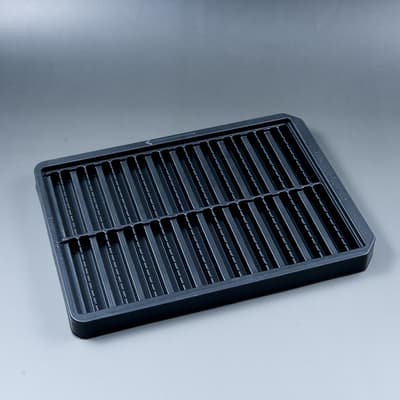
Double-layer blister trays, also known as double-layer plastic inserts, are made by thermoforming rigid plastic sheets into specific recessed shapes. Products are placed in the recesses for protection and presentation. Transport-type trays are also available, prioritizing convenience.
The raw material for blister trays is plastic sheet, generally no more than 1.5mm thick. Common materials include PVC, PET, PP, PS, as well as flocked sheets, gilded sheets, and anti-static sheets.
(1) A double-layer blister tray consists of a self-locking top cover, a bottom tray, and foldable side panels forming a complete modular plastic pallet. The top and bottom are made from HDPE, formed in a single thermoforming process. The middle panels can use PP hollow board or 7-layer corrugated board made into foldable side panels.
(2) The entire system is designed for repeated reuse. The top cover and bottom tray can be reused for up to ten years. Plastic and corrugated side panels can also be reused multiple times before replacement, greatly reducing customers' logistics and storage costs.
(3) All side panels are foldable, and the top and bottom can be nested or stacked, saving up to 50% storage space compared to traditional packaging.
(4) Both the double-layer top cover and bottom tray are thermoformed from two HDPE sheets in a single process — sturdy and durable.
(5) Assembly and disassembly of the double-layer blister tray is extremely convenient. No tools are needed; one person can complete the process in minutes. Four quick-lock buckles on each of the top and bottom secure the side panels, eliminating the need for strapping and saving on material and labor costs.